


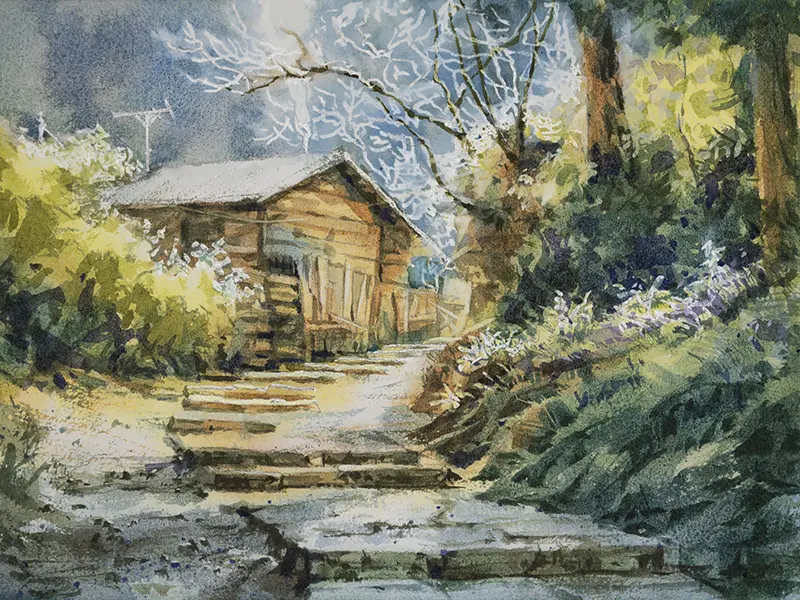
3 Watercolor Foreground, Midground, and Background Techniques to Add Depth
In watercolor painting, if a piece looks flat and lacks focus, it’s often due to unclear foreground, midground, and background arrangement. These three layers act like the front, middle, and back of a stage, guiding the viewer’s eye naturally into the scene and creating a sense of space and depth.
I. Why Does a Painting Need Foreground, Midground, and Background?
In nature, landscapes naturally have depth. From the small stones in the foreground, to the shrubs in the middle, and finally to distant mountains or the sky, this sense of depth makes the foreground, midground, and background in watercolor paintings feel more realistic and engaging.
If an entire painting is equally detailed, bright, or sharp, it can make the artwork feel flat and unfocused, leaving viewers unsure where to look. Arranging foreground, midground, and background helps you assign the main subject, secondary elements, and background, creating depth and visual rhythm.
II. 3 Key Techniques for Foreground, Midground, and Background in Watercolor
1. Color Value and Saturation
Foreground colors are usually the most saturated and intense; midground shifts to mid-tones; and background is rendered in light colors, grays, or cool tones, giving the effect of being “diluted by the air.” This is the most intuitive way to express depth in watercolor foreground, midground, and background.
2. Clarity and Level of Detail
The foreground is handled with the most detail, capturing veins, textures, and other fine elements; the midground simplifies details while keeping outlines; and the background retains only color blocks and blurred areas to create a sense of atmosphere.
3. Light–Dark Contrast and Edge Sharpness
Strong contrasts and clear edges should appear in the foreground; as distance increases, contrasts weaken and edges soften, creating depth in the watercolor foreground, midground, and background.
III. Common Mistakes by Beginners and How to Correct Them
- Mistake 1:The entire painting is equally detailed and colors are all saturated → Solution: Use layering; render the background in lighter colors.
- Mistake 2:No main focal point → Solution: Designate the foreground or midground as the main subject.
- Mistake 3:Background is too eye-catching → Solution: Reduce saturation and soften the edges.
IV. Practical Exercise Methods
- Choose a landscape photo.
- Mark the foreground, midground, and background layers.
- Paint using different concentrations and brushstrokes.
- Place the focal subject in the foreground or midground.
V. Conclusion
Mastering these 3 watercolor foreground, midground, and background techniques can give your paintings more depth and storytelling. This not only enhances the artistic expression but also allows viewers to truly “step into your painting.”
Further Reading
Watercolor Painting – Wikipedia
Recommended Courses
If you want to systematically learn more watercolor techniques, we recommend joining our courses:“Watercolor Course”



 Chinese
  English
  Japanese
  Korean