


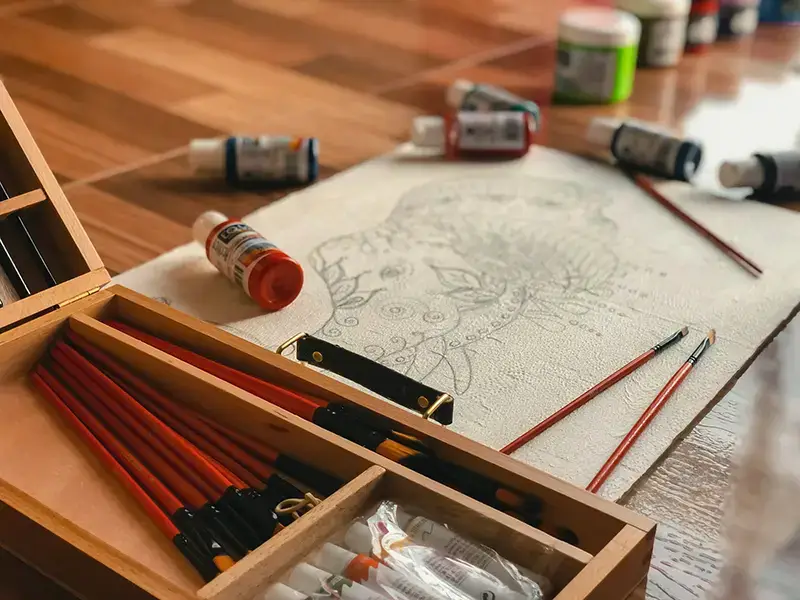
Many watercolor beginners feel that their paintings look flat and lack a focal point after finishing their work. The problem often lies in improper watercolor composition. This article summarizes 3 major watercolor composition techniques to help you quickly enhance the depth and professionalism of your artwork.
Rule of Thirds is the most classic composition method. Divide the canvas horizontally and vertically into three equal parts, and place the main subject at one of the four intersection points to create a more balanced and dynamic composition.
Diagonal composition is often used in landscapes and dynamic scenes, guiding the viewer’s eye and increasing visual tension.
The composition should have a clear primary and secondary focus, with a focal point, to clearly convey the creative intention.
| Incorrect Composition | Suggested Improvement |
|---|---|
| Subject placed dead center; the frame feels stiff | Move to the third-point intersection to increase visual tension. |
| The background is too busy, and the subject does not stand out. | Simplify the background and use light and dark contrast to highlight the main subject. |
| Elements are evenly distributed, with no focal point. | Focus on the main point and retain empty space. |
A phone camera is a great tool for practicing composition:
Further Reading: Composition – Wikipedia
Recommended Course:Watercolor Course

Ho Yeh Jianda — An expert in watercolor and oil painting instruction, graduated from the National Taiwan University of Arts, with 30 years of creative and teaching experience. Winner of multiple first prizes in national art exhibitions, he specializes in blending the lines of traditional Eastern ink painting with the brushwork of Western watercolor, guiding students from beginner to advanced levels to discover their own artistic style. For more courses, visit: Artify Ho Yeh Studio.



我們不會發送垃圾信,只會分享水彩課程新消息哦!
 Chinese
  English
  Japanese
  Korean